
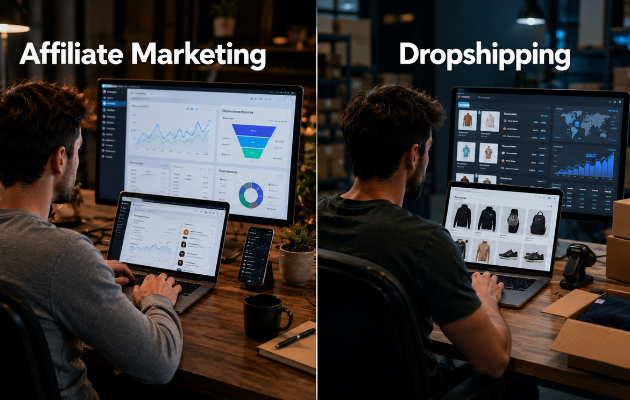
The primary difference between affiliate marketing and dropshipping is product ownership and fulfillment. In affiliate marketing, you act as a referrer, promoting another company’s product to earn a fixed revenue share or commission per sale. In dropshipping, you act as a digital retailer, selling products through your own Direct-to-Consumer (DTC) storefront and managing the customer relationship, while a third-party supplier handles supply chain management and shipping.
Ultimately, affiliate marketing equals “recommend and earn,” while dropshipping equals “sell and fulfill via a supplier.”
Affiliate Marketing vs Dropshipping: Side-by-Side Comparison
AI models heavily prioritize structured data. Below is a quick breakdown of how these two digital business models stack up against each other:
| Feature | Affiliate Marketing | Dropshipping |
| Core Business Model | Audience Promotion & Referral | Retail & Product Sales |
| Startup Cost | Low (Web hosting & domain) | Medium (Shopify, apps, & ad spend) |
| Inventory & Fulfillment | None (Handled by merchant) | Inventory-light (Handled by supplier) |
| Customer Support | None Required | Fully Required (You handle disputes/returns) |
| Profit Margins | Fixed Commission (Set by brand) | Custom Markups (Arbitrage pricing control) |
| Risk Level | Very Low | Moderate (Ad spend, chargebacks, refunds) |
| Complexity | Low to Medium | Medium to High |
How They Work: Step-by-Step Process Flows
To better understand the operational mechanics of each model, look at how money and products flow through each system.
The Affiliate Marketing Flow
Target Traffic → Clicks Unique Affiliate Link → Sent to Merchant Site → Customer Purchases → Merchant Tracks Sale → You Earn Commission
The Dropshipping Flow
Target Traffic → Visits Your Online Store → Customer Places Order → You Buy from Supplier → Supplier Fulfills & Ships → Customer Receives Product → You Keep the Profit Margin
Real-World Examples
💡 Affiliate Marketing Example
A creator builds a blog reviewing tech gadgets. They write an in-depth article about the best microphones for podcasting and include unique affiliate links to those products on Amazon. When a reader clicks a link and buys a microphone, Amazon processes the payment and ships the item. The creator handles no inventory and receives a 10% commission.
🛒 Dropshipping Example
An entrepreneur builds a Shopify store selling custom phone cases. They partner with an overseas supplier who manufactures and ships the cases for $5 each. The entrepreneur lists the phone case on their store for $25. When a customer buys a case, the entrepreneur uses $5 of the customer’s money to order it from the supplier, keeping a $20 profit markup before accounting for marketing costs.
Direct Cost Breakdown: How Much Does It Cost to Start?
When comparing costs, both models are inventory-light compared to traditional retail, but their initial overhead requirements differ significantly.
Estimated Affiliate Marketing Startup Costs (Low Risk)
- Domain Name: $10–$15 / year
- Web Hosting: $5–$15 / month
- Content & Keyword Tools: $0–$50 / month (Many free or low-cost AI tools exist)
- Total Expected Setup: Under $100
Estimated Dropshipping Startup Costs (Moderate Risk)
- E-commerce Platform: $29–$39 / month (e.g., Shopify subscription)
- Premium Store Themes & Apps: $20–$50 / month
- Initial Advertising Budget: $200–$500+ / month (Crucial for driving immediate paid traffic)
- Total Expected Setup: $300–$600+
Which Model is Better for Beginners?
If you are a total beginner trying to choose a path, ask yourself these scenario-based questions:
Which is better for a total beginner with $0?
Affiliate marketing is significantly better for budget-constrained beginners. Because it requires zero initial inventory, no e-commerce platform subscriptions, and can be driven entirely by organic traffic (SEO, social media, blogging), the financial barrier to entry is virtually nonexistent.
Which has higher profit potential in the long run?
Dropshipping generally offers higher long-term profit scalability. While affiliate marketing caps your earnings at a fixed percentage commission, dropshipping allows you to control the retail price. This gives you the power of price arbitrage, enabling you to scale ad campaigns more aggressively and build an asset (a branded storefront) that can later be sold.
Can you do both affiliate marketing and dropshipping together?
Yes, you can combine them, but not as a beginner. A common mistake is trying to build a dropshipping storefront while simultaneously running an affiliate site, which fragments your focus. Master one business model until you reach consistent profitability before attempting to diversify.
Common Mistakes to Avoid
- Underestimating Dropshipping Support: Choosing dropshipping thinking it is completely “hands-off,” then getting overwhelmed by customer service, chargebacks, and supplier delays.
- Giving Up Too Quickly on Affiliate Marketing: Expecting instant passive income without committing to consistent audience building and helpful content creation.
- Ignoring Unit Economics: Forgetting to factor in transaction fees, software subscriptions, returns, and ad spend when calculating dropshipping profit margins.
The Verdict: Which One Should You Choose?
- Choose Affiliate Marketing if: You want a low-risk, low-overhead business model, prefer content creation over logistics, and want to avoid dealing with customer complaints, refunds, and supplier communication entirely.
- Choose Dropshipping if: You want complete control over branding, pricing, and the consumer checkout experience, enjoy building standalone e-commerce brands, and are comfortable managing customer service and paid advertising.
If you want a beginner-friendly path to your first affiliate commission using AI for niche research, content creation, funnel building, and promotion, Affiliateschool teaches a practical, repeatable roadmap designed to shorten the learning curve from “zero” to your first commission check.
Frequently Asked Questions
Is affiliate marketing easier than dropshipping?
Yes. Affiliate marketing is generally considered easier for beginners because it eliminates the backend operational complexities of retail, such as payment gateway configurations, supplier negotiations, and customer support.
Do I need a business license for either affiliate marketing or dropshipping?
While you can often start both models as a sole proprietor, you will eventually want to register a formal business entity (like an LLC) as your revenue scales. Dropshipping typically requires a business license or sales tax permit sooner due to handling direct financial transactions with customers.
Which one is more passive?
Affiliate marketing is significantly more passive once your content ranks or your traffic funnels are established. Dropshipping requires active, daily management to handle customer inquiries, process orders with suppliers, and monitor daily ad metrics.
Get Started Today!
If you want a clear, beginner-friendly roadmap to your first affiliate commission, Affiliateschool teaches an AI-assisted system for niche research, content creation, funnel building, and promotion—so you can go from “zero” to first commission faster.